


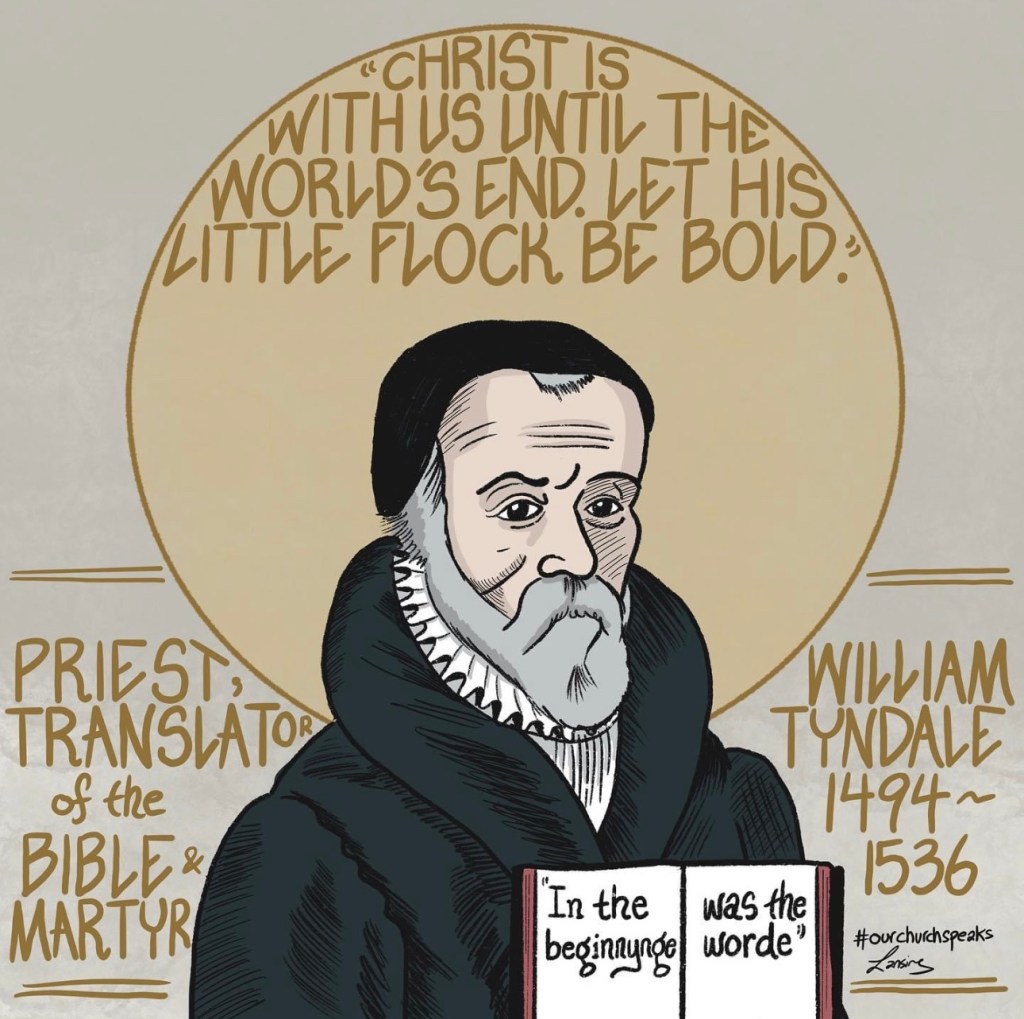
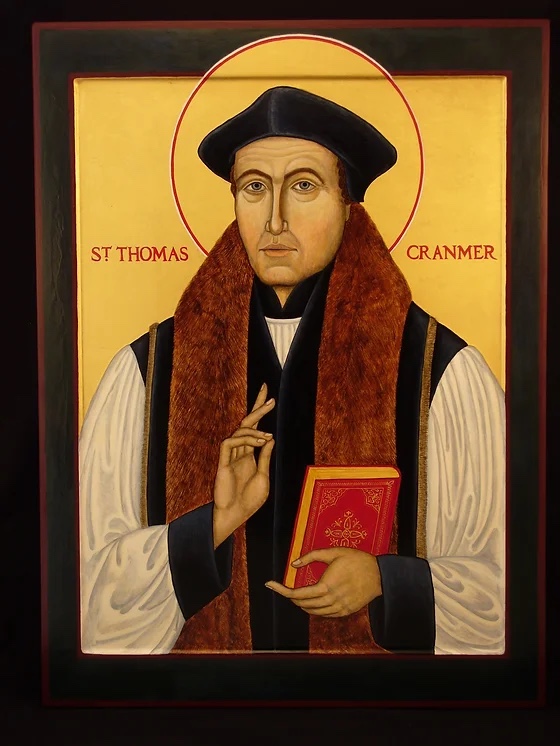


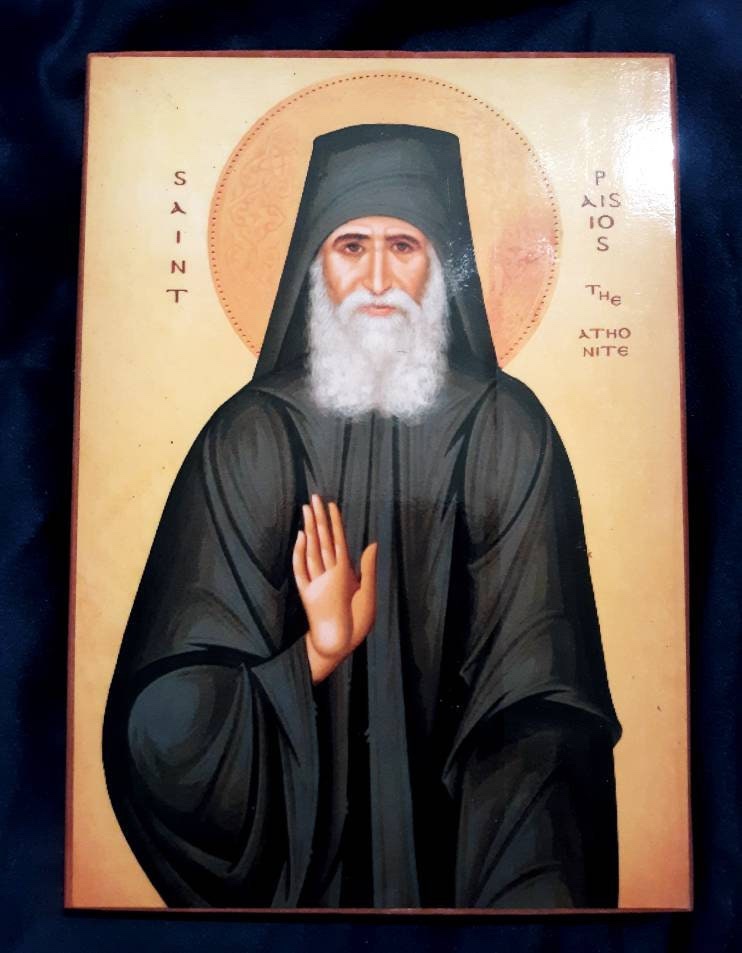
I call it the “epic lineup” because I joke it’s something that would make everyone mad.
If these icons hung altogether on a wall many passerby’s would not think much of it. But there is a lot of history here. And someone who really understood the history would go “what?” It might make them mad. In life I do not these great Christians would have gotten along very well. Some of them even wrote to or know each other in life, and suffice it to say they were not friends. But I very much hope that is not the case in death. The “epic lineup” so far consists of:
John Calvin
Martin Luther
Francis de Sales
Pius V
Thomas More
William Tyndale
Thomas Cranmer
Alexis Toth
John Henry Newman
Cyril Lucaris
Paisios
According to at least one Christian tradition, each person here is celebrated either explicitly or de facto as a Saint, as orthodox, hence the existence of their icons. Each person here loved Jesus Christ and thought they were in the right, thought they were defending the One, Holy, Catholic, and Apostolic Church against heresy and error. What did they do?
John Calvin led many Catholics into the Reformed Tradition. Francis de Sales led many Calvinized former Catholics back into the Catholic faith.
Martin Luther led many Catholics into the Lutheran tradition sparking the Protestant Reformation, and was avidly criticized by Thomas More and vice versa. Thomas More and Tyndale were enemies in many respects and mutually criticized each other, More was falsely accused by some of the reformers. When More refused to say that Henry VIII was the rightful head of the Church of England, he was killed and died a martyr of the Catholic faith. Thomas Cranmer, who composed the Book of Common Prayer and Protestantized the Church of England, was there when Thomas More was killed. He also died under Bloody Mary’s persecution of Protestants putting his hand into the fire which signed a retraction of his Protestant faith in defiance.
Later John Henry Newman, a significant figure of the “Anglo-Catholic” Oxford movement within the Church of England, became convinced the Church of Rome was the one true Church established by Jesus Christ and left the Church of England as a result, eventually becoming a Cardinal. Pius V was a Pope and leader of the counter-Reformation after Luther’s death.
Many historians agree that Cyril Lucarius who was very anti-Papal, tried to Calvinize Eastern Orthodoxy. Alexis Toth led 100,000 eastern-rite Catholics out of the Catholic church and into the Orthodox church leading to the founding of the Orthodox Church in America. Paisios was an Athonite monk who wouldn’t say an Our Father with latin (Catholic) visitors because he did not consider them to be of the same faith, I suspect he had harsher attitudes still for Protestants.
All this history. In spite of all this, are they not all brothers in Christ? I believe this to be the case.
Yet they all disagreed with one another. Who was in the right?
I don’t know what the truth is more than any of these men. I say the truth is in Christ, but so did they. I say it’s important to get the faith right, but so did they, and they hardly agreed with one another on these matters of contention. I hope and pray God has mercy on those who er in such matters, and those led by them. But what of us? Am I more sure than they?
When one insists dogmatically that an encounter of Christ is false because Jesus did not tell the visionary to join the Eastern Orthodox Church or the Catholic Church or the Protestant Church but something else, even if he is rejecting genuine personal revelation, does God overlook his stubbornness as a part of his faith or condemn it as pride? Is it the virtue of humility or the vice of lack of faith to say “I don’t know who is right. I don’t know where the fullness of truth is to be found”? I do not know.
Each of these men would answer in life “it’s here! The fullness of truth is here!” But who are they? They claim to do the will of God, but what does God say? Lord help me for I do not know. Many saints say prayer and fasting is the way to discern such questions, not thinking and the rational mind. I think perhaps this is true. The rational mind is not the infallible guide modernity often makes itself out to be.
For instance,
“Elder Paisios teaches: ‘The devil does not hunt after those who are lost; he hunts after those who are aware, those who are close to God. He takes from them trust in God and begins to afflict them with self-assurance, logic, thinking, criticism. Therefore we should not trust our logical minds. Never believe your thoughts.
‘Live simply and without thinking too much, like a child with his father. Faith without too much thinking works wonders. The logical mind hinders the Grace of God and miracles. Practice patience without judging with the logical mind.’
Elsewhere Elder Paisius counseled: ‘We ought always to be careful and be in constant hesitation about whether things are really as we think. For when someone is constantly occupied with his thoughts and trusts in them, the devil will manage things in such a way that he will make the man evil, even if by nature he was good.’”
“The ancient fathers did not trust their thoughts at all, but even in the smallest things, when they had to give an answer, they addressed the matter in their prayer, joining to it fasting, in order in some way to ‘force’ Divine Grace to inform them what was the right answer according to God. And when they received the ‘information,’ they gave the answer.
“Today I observe that even with great matters, when someone asks, before he has even had the time to complete his question, we interrupt him and answer him. This shows that not only do we not seek enlightenment from the Grace of God, but we do not even judge with the reason God gave us. On the contrary, whatever our thoughts suggest to us, immediately, without hesitation, we trust it and consent to it, often with disastrous results.
“Almost all of us view thoughts as being something simple and natural, and that is why we naively trust them. However, we should neither trust them nor accept them.
“Thoughts are like airplanes flying in the air. If you ignore them, there is no problem. If you pay attention to them, you create an airport inside your head and permit them to land!”
Yet I know here St. Thomas Aquinas may here have disagreed with St. Paisios to a large extent. Reason certainly is not useless.
So you see, I am still figuring things out. For myself and my discernment, I cannot speak highly enough of the Surrender Novena, and I always say:
Lord Jesus Christ, Son of God, have Mercy on me a sinner.
What are your thoughts?

 Crossing The Jordan
Thank you for this. I am a Presbyterian who has been dealing with ecclesial anxiety for over a year now. I feel like no matter what group I belong to, someone will always have a convincing argument to make that I am damned. Honestly I am in a very bad place because of all of this. I promised myself beforehand that I may give up or change some beliefs through this process, but I will never give up Christ. Right now I feel as though he has been taken away from me. This is truly an awful place to be, and I have spoken to so many others like me in many different camps that are experiencing the same thing. I fear that, if all our energies are put forth to discredit and disprove one another, then the sum of all these arguments will equate to atheism. I know many good and convincing arguments against every Christian tradition. If I am convinced by all of these at once, where does that lead me? Nowhere, faithless. I pray that I will never lose sight of Christ, but I can see how this would lead some to apostatize totally. Praying for a more united future among our brothers and sisters in Christ. Keep up the good work, christian soldier!
LikeLike
Oh I went through it for nearly 2 years after I became a Roman Catholic. “Is this really true? What about this? What about that?” For me the only thing I kept going back to were the promises and assurances of the Gospel. Romans 5:1 and John 5:24 were God sends (no pun intended) for me.
I had a major crisis of faith because I was practicing a religion that my conscience was convicting me I knew deep down wasn’t the “fullness of truth” it claimed to be. Specifically, that it was wrong on the doctrine of justification, that the Roman sacramental system and many of its beliefs and dogmas while in many ways beautiful, were far more a result of medieval scholasticism and the traditions of men than divine institution. Its legalistic approach to salvation, mortal and venial sins, etc. and the ambiguities thereof were like cancer for my mental health.
I stepped away and have been going to a PCUSA Presbyterian church for a while after lots of church hopping. I felt God’s presence there strongly when I visited. I’m “resting” for lack of a better word, still praying often the daily office of the Book of Common Prayer and taking a break from religious anxiety and debates. Deleting my old YouTube account did wonders for my mental health. I created a new one and moved my Premium subscription to it and allowed no religious or political content on it. You should watch Ortlund’s Truth Unites on YouTube as he addresses a lot of ecclesial anxiety. His solution was mine— take God at his word. Romans 5:1, John 5:24. It isn’t that easy in practice though I know that. Today a Muslim video popped up saying Christians are damned because they call upon Jesus who according to them is a “helper” of Allah. No one really fully knows and speaks as if they are God’s own voice, they aren’t worth paying any mind. What matters is the heart and that we love God and love people. Rest assured you’re in my prayers. God be with you.
Jordan
LikeLike